Have you ever noticed that Korean sentences often place the main action or state at the end? Unlike English, which generally places the verb before the object, Korean usually places the object before the verb. However, word order is only one aspect of how meaning is conveyed in a language.
The way information is arranged within a sentence can help us understand how ideas are connected. In everyday conversations, we also rely on context to understand what someone means, even when part of the message is left unsaid. By looking at Korean sentence structure and everyday examples, we can explore how word order and context work together to shape meaning.
1. Understanding Korean Word Order
The Same Meaning, Different Information Order
Different languages can express the same idea while organizing information in different ways. Comparing English and Korean helps us see how this works.
Consider these two English sentences:
- I went to bed after I brushed my teeth.
- After I brushed my teeth, I went to bed.
Both sentences describe the same sequence of events. However, the information is presented in a different order. The first sentence introduces the main action, going to bed, before explaining when it happened. The second introduces the earlier event, brushing one’s teeth, before presenting the main action.
In Korean, the same idea can be expressed as:
양치를 한 후에 잠자리에 들었다.
“I went to bed after brushing my teeth.”
In this Korean sentence, 양치를 한 후에 means “after brushing one’s teeth,” while 잠자리에 들었다 means “went to bed.” The time expression comes first, followed by the main action.
A sentence is therefore more than a collection of words and their individual meanings. The way information is ordered and connected can influence how readers and listeners process a message.
How Do Korean and English Differ in Word Order?
Korean and English differ in how they typically arrange the main components of a sentence.
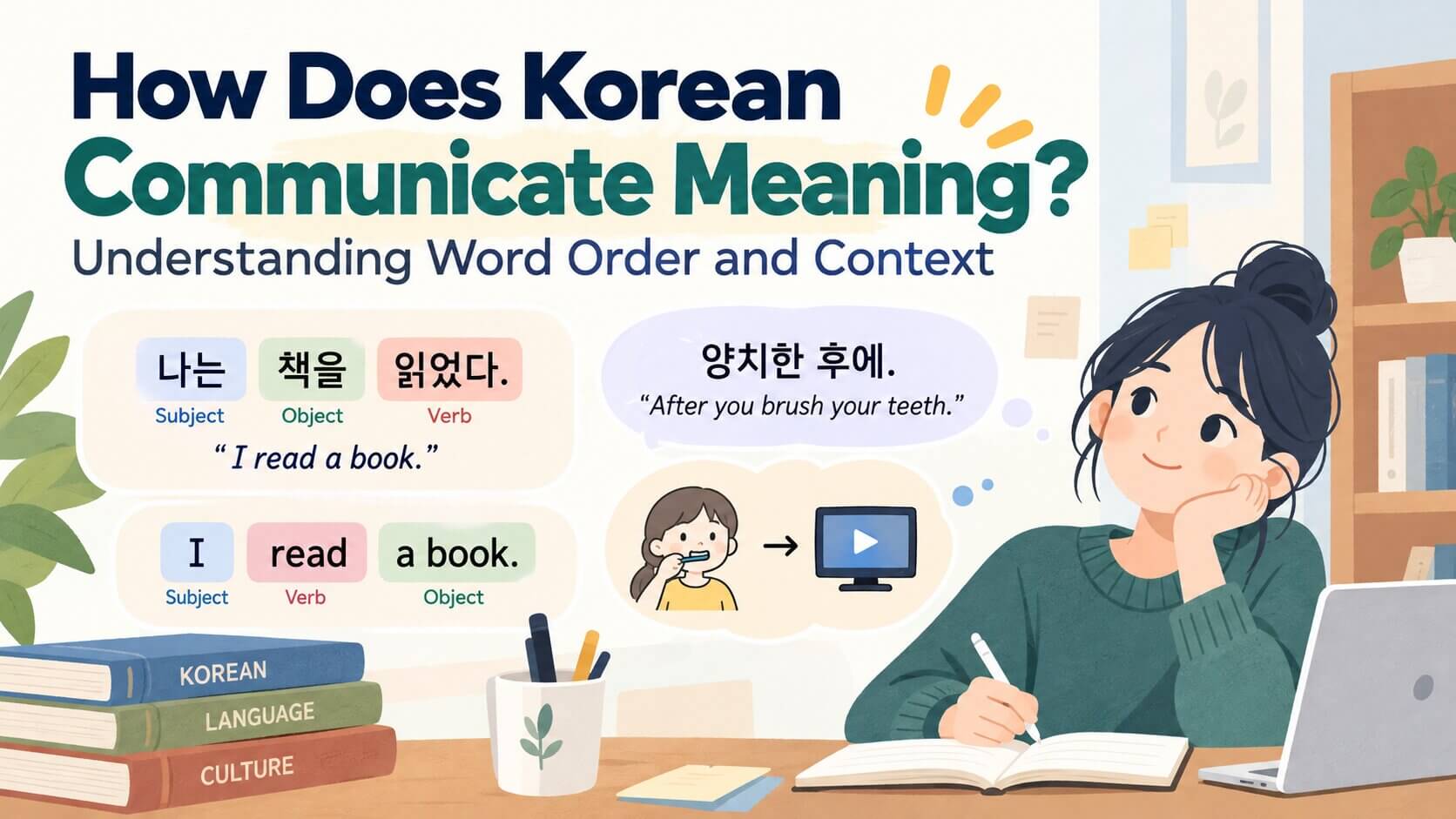
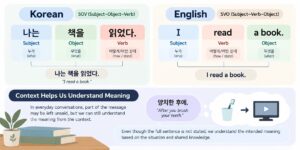
English generally follows Subject–Verb–Object (SVO) word order, whereas Korean generally follows Subject–Object–Verb (SOV) word order.
Compare the following sentences:
- Korean: 나는 책을 읽었다.
- English: I read a book.
In Korean, the subject 나는 (“I”) is followed by the object 책을 (“a book”), and the verb 읽었다 (“read”) comes at the end. In English, the subject I is followed by the verb read, and the object a book comes afterward.
In Korean, the predicate—the part of the sentence that expresses an action, state, or quality—generally appears at the end. This feature is not limited to sentences containing an object. Korean predicates can also describe states or qualities.
Consider this example:
날씨가 춥다.
“The weather is cold.”
Here, 날씨가 means “the weather,” and 춥다 means “is cold.” The word 춥다 is an adjective functioning as the predicate. Although the sentence has no object, the predicate still appears at the end.
Understanding this feature helps learners recognize that Korean word order involves more than the position of the object relative to the verb.
However, neither Korean nor English uses only one fixed order in every situation. English can place a time or condition clause at the beginning of a sentence, and Korean can also arrange information in different ways depending on the context and what the speaker wants to emphasize.
The important point is not simply to memorize a particular word order, but to understand the role each part plays in conveying meaning.
How Does Earlier Information Help Us Understand What Comes Next?
Information about time, conditions, and reasons can appear before the main action or result. Such information provides clues that help listeners understand what follows.
Consider this Korean sentence:
만약 내일 비가 온다면, 소풍을 취소할 것이다.
“If it rains tomorrow, we will cancel the picnic.”
The sentence first introduces a condition: it may rain tomorrow. It then presents a possible result: canceling the picnic. By hearing the condition first, the listener can understand how it relates to the decision that follows.
The same pattern can be found in sentences expressing cause and effect.
비가 많이 와서 약속 시간에 늦었다.
“Because it rained heavily, I arrived late for the appointment.”
The reason for arriving late appears first, followed by the result. Connecting the cause with the outcome helps the listener understand the meaning of the complete sentence.
English can present the information in the same order:
- If it rains tomorrow, we will cancel the picnic.
- Because it rained heavily, I arrived late for the appointment.
Therefore, presenting a condition or reason before the main result is not unique to Korean. Both languages allow speakers to organize information in different ways.
Nevertheless, understanding Korean’s predicate-final structure can be useful. As learners listen to or read a sentence, they can keep track of the information presented earlier and connect it to the action or state expressed by the predicate at the end.
2. Understanding Meaning Through Context
What Does “양치를 한 후에” Really Mean?
Understanding a sentence involves more than recognizing its grammatical structure. In everyday conversation, listeners also use context to interpret what a speaker means.
People do not always express every part of a message in a complete sentence. Information that is already clear from the preceding conversation or the situation can be left unstated.
Consider this exchange:
Daughter: “Mom, can I watch Frozen?”
Mother: “양치한 후에.”
The mother’s response means “After you brush your teeth.” Taken on its own, the expression does not specify what should happen after brushing one’s teeth.
Nevertheless, the daughter can reasonably understand that she may watch the movie after brushing her teeth. Because she has just asked permission to watch it, she connects her mother’s response to that request.
The mother does not need to say, “You can watch the movie after you brush your teeth.” The preceding question helps the daughter understand the missing part of the message.
This is an example of pragmatic inference: listeners use context to infer meaning that has not been explicitly stated. They consider not only the literal meaning of the words but also what was said before and what is happening in the situation.
The response does not necessarily mean that the mother has granted permission in every possible context. Depending on the situation and the mother’s intention, it might instead emphasize that brushing her teeth must come first. The intended meaning depends on the flow of the conversation.
This phenomenon is not unique to Korean. An English-speaking parent might respond to “Can I watch a movie?” by saying, “After you brush your teeth.” The response is not a complete sentence in isolation, but the preceding question helps the child understand what the parent means.
The important distinction is that Korean’s predicate-final structure is a grammatical feature, whereas inferring unstated meaning is a process that depends on conversational context.
How Are Sentence Structure and Conversational Context Related?
Sentence structure and conversational context both contribute to understanding meaning, but they play different roles.
Sentence structure shows how information is arranged and connected within a sentence. It helps readers and listeners understand how expressions of time, conditions, and reasons relate to the main action or result.
Conversational context, on the other hand, helps listeners understand how an expression relates to what has already been said and what the speaker intends to communicate in a particular situation.
In the conversation between the mother and daughter, the expression “양치한 후에” indicates a time relationship. Because the daughter has already asked to watch a movie, however, the listener can interpret the response as an answer to that request.
Without the preceding conversation, it would be difficult to know what the mother expects to happen after the daughter brushes her teeth. Understanding the basic meaning of an expression is not the same as understanding the speaker’s intention in a particular conversation.
For Korean learners, it is useful to consider both aspects. Understanding sentence structure helps them recognize how the parts of a sentence relate to one another, while considering context helps them interpret short responses and expressions whose meanings are not fully stated.
3. Applying These Ideas to Korean Learning
How Can Korean Learners Follow the Flow of Information?
When reading or listening to Korean, learners can improve their comprehension by paying attention to how information is connected rather than translating each word in isolation.
The following questions can help:
- What is the predicate? Identify the part of the sentence that expresses the main action, state, or quality.
- What information appears before it? Look for expressions of time, conditions, reasons, or circumstances.
- How are the parts connected? Determine whether the earlier information establishes a condition, gives a reason, or explains when an action takes place.
- What does the context tell me? If a response is short, consider whether the preceding question or statement helps you infer what has been left unsaid.
It is also useful to avoid deciding on the meaning of a Korean sentence too early when listening. Since the predicate generally appears at the end, learners may need to retain the information they have already heard and connect it to the predicate when it arrives.
When practicing conversation, learners can also examine short responses in relation to the preceding exchange. Not every response is expressed as a complete sentence, and speakers can leave some information unstated when it is already clear to the people involved.
These strategies help learners develop both their understanding of Korean grammar and their ability to interpret meaning in real conversations.
4. Conclusion
Understanding How Korean Communicates Meaning
Korean’s typical SOV word order and predicate-final structure provide a starting point for understanding how information is organized within a sentence. Recognizing how expressions of time, conditions, and reasons connect to the predicate helps learners understand how the parts of a sentence work together.
In everyday conversation, another skill becomes important: interpreting context. Speakers do not always state everything explicitly, and listeners often infer unstated meaning from the preceding conversation and the situation.
Grammar helps explain how information is arranged and connected within a sentence. Context helps listeners understand what a speaker intends to communicate in a particular situation. To understand Korean accurately, learners need to distinguish between these two aspects while recognizing how they work together.
Learning Korean therefore involves more than memorizing vocabulary and grammatical rules. It also involves following how information develops within a sentence and using context to understand a speaker’s intention.
Understanding Korean means not only knowing the meanings of individual words, but also following the flow of information and using context to understand what a speaker intends to communicate.