

When learning Korean, you may notice that the same English subject, *I*, is translated as either *naneun* (나는) or *naega* (내가). Although both expressions refer to the same person, the choice of particle can change how the sentence is understood and how it fits into a conversation.
This difference is not simply a matter of translating English grammar into Korean grammar. In Korean, particle choice is influenced by several factors, including what the speaker treats as the topic, what the speaker wants to emphasize, what information has already been introduced, and the context of the conversation.
So, what is the difference between `은/는` and `이/가`, and how can you choose the appropriate particle in everyday Korean? Let’s explore the difference through practical examples.
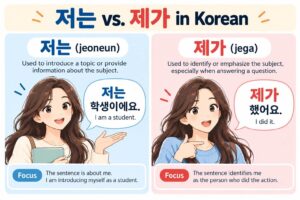
1. Why Does the Same “I” Become 나는 or 내가 in Korean?
In English, I functions as the subject of a sentence. In Korean, however, different particles can follow the same pronoun depending on the sentence structure and conversational context.
Consider the following examples:
- I am a student. → 저는 학생이에요.
- I am the one who did it. → 제가 그 일을 한 사람이에요.
In both English sentences, I is the subject. In Korean, however, the first sentence uses 는, while the second uses 가.
In the first sentence, the speaker is describing themselves as a student. In the second, the focus is on identifying the person who did the task. This difference shows that Korean particles do more than simply mark the subject of an English sentence.
It is also important to distinguish between pronoun choice and particle choice. 저 is the humble form of 나. Accordingly, 저는 and 제가 are the humble counterparts of 나는 and 내가, respectively. The choice of pronoun and the choice of particle are related, but they are not the same grammatical issue.
2. Why Is 제가 했어요 More Natural Than 저는 했어요?
To understand the difference between 은/는 and 이/가, we need to consider not only the sentence itself but also the question being asked.
Imagine someone asks:
Q: Who did it?
누가 이 일을 했나요?
A: I did it.
제가 했어요.
The question asks who performed the task. The answer 제가 했어요 is natural because it identifies the speaker as the person who did it.
What if the speaker answered 저는 했어요 in the same situation? The response would sound somewhat out of step with the focus of the conversation. Unless the speaker deliberately intends to shift the focus away from the question, 제가 했어요 is more appropriate than 저는 했어요.
This does not mean that 저는 했어요 is grammatically incorrect. It can be natural when the context is different, especially when contrasting one person’s actions with another’s.
For example:
- 저는 했어요. 그런데 민수는 안 했어요.
- I did it, but Minsu didn’t.
Here, 저는 and 민수는 contrast two people and their actions. The appropriate particle therefore depends not only on the grammatical form of the sentence but also on the purpose of the conversation.
3. How Does Context Change the Choice Between 철수가 and 철수는?
The distinction between 은/는 and 이/가 applies not only to personal pronouns but also to names and other nouns.
Consider these two sentences:
- 철수가 어제 도서관에 갔습니다.
- 철수는 어제 도서관에 갔습니다.
Both sentences state that Cheolsu went to the library yesterday. However, one may be more natural than the other depending on the question being answered.
3.1. Who Went to the Library Yesterday?
Q: Who went to the library yesterday?
누가 어제 도서관에 갔나요?
A: 철수가 어제 도서관에 갔습니다.
The question asks who went to the library. The answer focuses on identifying the person who performed the action. In this context, 철수가 is natural.
3.2. What Did Cheolsu Do Yesterday?
Q: What did Cheolsu do yesterday?
철수는 어제 무엇을 했나요?
A: 철수는 어제 도서관에 갔습니다.
This time, the question is not about who Cheolsu is but about what he did yesterday. Cheolsu is the topic, and the sentence provides information about him. In this context, 철수는 is natural.
These examples show that the same event can be described using different particles depending on the focus of the conversation. Rather than memorizing each sentence in isolation, it is helpful to consider the question that the sentence answers.
4. Why Can the Same English Sentence Become 치타는 or 치타가?
When translating English into Korean, the English subject does not always correspond directly to the Korean subject particle 이/가.
Consider the following sentence:
Cheetahs are the fastest land animals.
Depending on the context, it can be translated in two ways:
- 치타는 가장 빠른 육상동물입니다.
- 치타가 가장 빠른 육상동물입니다.
Although both sentences convey the same basic information, they differ in how the information is presented. 치타는 presents cheetahs as the topic, while 치타가 can be used when the focus is on identifying which animal is the fastest land animal.
For example, if someone asks, “What is the fastest land animal?” (가장 빠른 육상동물은 무엇인가요?), one possible answer is 치타가 가장 빠른 육상동물입니다. The speaker could also answer 가장 빠른 육상동물은 치타입니다. or simply 치타입니다. These answers express the same basic fact but organize the information differently.
The choice between 은/는 and 이/가 therefore depends on the conversational context and how the speaker presents the information. Rather than matching an English subject to a Korean particle mechanically, it is more useful to consider what the sentence is intended to communicate in a particular situation.
5. How Does Given and New Information Affect Particle Choice?
Another factor that helps explain Korean particle choice is the distinction between information that is already known and information that is newly introduced.
Given information refers to information that has already been mentioned or that the speaker assumes the listener knows. New information refers to information being introduced into the conversation for the first time.
Consider the following opening from a story:
옛날에 백설공주와 왕비가 살고 있었습니다. 어느 날 왕비는 거울에게 물었습니다.
In the first sentence, Snow White and the queen are introduced as characters in the story. The particle 가 can be used to introduce these new referents.
In the second sentence, the queen has already been introduced. The sentence now takes the queen as its topic and describes what she does next. This is why 왕비는 is natural in this context.
In this way, 은/는 is often used when a previously mentioned referent is taken as the topic and further information about it is provided.
The distinction between given and new information helps us understand the use of 은/는 and 이/가. However, it would be inaccurate to reduce the distinction to the following simple equations:
은/는= given information이/가= new information
Such a simplified mapping cannot fully explain how these particles are used in actual Korean. Although 은/는 is frequently used when an already known referent is taken as the topic, it can also introduce new information or express contrast. Conversely, a noun marked with 이/가 may have been mentioned earlier in the conversation.
Therefore, given and new information should be understood as one factor influencing particle choice. To understand the difference between the two particles, we must also consider which referent is treated as the topic, what receives the focus, and how the information fits into the conversational context.
6. How Can You Choose Between 은/는 and 이/가?
The examples above suggest several useful considerations when choosing between these particles.
First, consider what the question is asking.
- 누가 왔어요? → 민수가 왔어요.
- 민수는 무엇을 했어요? → 민수는 도서관에 갔어요.
The first question asks who performed the action. The second asks for information about Minsu, who has already been established as the topic.
Second, consider which person or thing is being treated as the topic.
- 저는 커피를 좋아해요.
- 동생은 차를 좋아해요.
In these sentences, the speaker talks about their own preference and then contrasts it with their younger sibling’s preference. The particle 은/는 helps establish the topics and express the contrast between them.
Third, consider whether a new referent is being introduced.
- 누가 이 일을 했어요? → 제가 했어요.
- 옛날에 백설공주와 왕비가 살고 있었습니다.
In the first example, the answer identifies the person who performed the action. In the second, the characters are introduced into the story.
These tendencies are useful guidelines, but they are not absolute rules that can be applied mechanically to every sentence. In actual Korean, particle choice is influenced by sentence meaning, conversational context, and the flow of information.
Conclusion
The difference between 은/는 and 이/가 cannot be explained simply by translating English subjects into Korean. These particles are connected to what the speaker treats as the topic, what receives the focus, and how information is presented in a conversation.
As the examples 저는 versus 제가, 철수는 versus 철수가, and 치타는 versus 치타가 demonstrate, the more natural particle can change depending on the context, even when the same person or thing is being discussed and the basic information remains similar.
To understand these particles, it is therefore important to do more than memorize their forms individually. Consider the situation in which a sentence is used and the question it answers. Comparing questions and answers is a particularly useful way to understand when Korean speakers choose 은/는 and when they choose 이/가.