

When learning Korean, you will discover that both 안 and 못 are used to express negation. However, they differ in meaning and usage. In English, 안 often corresponds to don’t, doesn’t, or not, while 못 often corresponds to can’t or cannot. However, the difference between these Korean expressions cannot always be explained through direct English translations alone.
For example, both 오늘은 학교에 안 가요 and 오늘은 학교에 못 가요 describe a situation in which someone is not going to school today. However, the two sentences convey different nuances.
In this article, we will explore the basic meanings and usage of 안 and 못, examine how they differ in everyday conversations, and learn how context can affect their meanings.
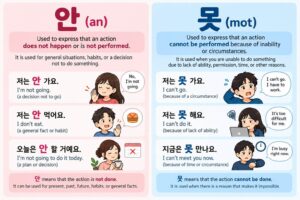
The Meaning and Usage of 안
안 is used to negate an action or describe a state that does not apply. It generally appears before verbs and adjectives to make a sentence negative.
For example:
- 안 가요. — I don’t go. / I’m not going.
- 안 먹어요. — I don’t eat. / I’m not eating.
- 안 좋아해요. — I don’t like it.
- 안 비싸요. — It’s not expensive.
안 가요 means that the action of going does not take place, while 안 먹어요 means that someone does not eat something. 안 좋아해요 negates a feeling or preference, and 안 비싸요 describes something that is not expensive.
As these examples show, 안 can be used to negate both actions and states or qualities.
However, using 안 does not necessarily mean that someone has deliberately decided not to do something. For example, the sentence 오늘은 학교에 안 가요 simply states that the speaker is not going to school today. The speaker may have chosen not to go, but there may also be other reasons.
Therefore, the basic function of 안 is to negate an action or state. The specific reason or intention behind it depends on the context.
The Meaning and Usage of 못
못 expresses that someone cannot perform an action or is unable to do something because of certain circumstances. It generally appears before verbs.
For example:
- 못 가요. — I can’t go.
- 못 먹어요. — I can’t eat it.
- 못 읽어요. — I can’t read it.
- 못 만나요. — I can’t meet you.
못 가요 means that someone is unable to go for some reason. 못 먹어요 indicates that someone cannot eat something in a particular situation. 못 읽어요 may mean that someone lacks the ability to read something or is unable to read it under the circumstances. 못 만나요 can indicate that someone cannot meet another person because of a scheduling conflict or another reason.
An important point is that 못 does not necessarily mean a lack of ability. Sometimes it indicates that someone lacks the ability to perform an action, but it can also describe a situation in which time constraints or other circumstances prevent the action from taking place.
For example, someone who is not proficient in Korean might say 한국어를 잘 못해요, meaning “I’m not very good at Korean.” In contrast, someone who cannot meet a friend because of another commitment might say 오늘은 친구를 못 만나요, meaning “I can’t meet my friend today.”
Both sentences use 못, but the first refers to a limitation in ability, while the second describes a situational constraint.
The Difference Between 안 가요 and 못 가요
The difference between 안 and 못 becomes easier to understand when we compare two sentences describing the same action.
- 오늘은 학교에 안 가요. — I’m not going to school today.
- 오늘은 학교에 못 가요. — I can’t go to school today.
The first sentence states that the speaker is not going to school today. However, the sentence alone does not tell us why. The speaker may have decided not to go, or there may be another reason.
The second sentence suggests that something prevents the speaker from going to school. For example, the speaker might be ill, have another commitment, or face an unavoidable circumstance.
The difference, therefore, is not simply whether an action is negated. 안 generally focuses on the fact that an action does not take place, while 못 emphasizes an inability or constraint that prevents the action from happening.
Of course, context matters in real conversations. 안 가요 does not necessarily indicate a voluntary choice, and 못 가요 does not necessarily mean that the speaker lacks the physical ability to go somewhere.
Comparing 안 and 못 in Everyday Korean
Let’s look at a few common expressions to understand the difference more clearly.
고기를 안 먹어요 vs. 고기를 못 먹어요
- 고기를 안 먹어요. — I don’t eat meat.
- 고기를 못 먹어요. — I can’t eat meat.
고기를 안 먹어요 means that the person does not eat meat. This might be due to personal preference or eating habits. However, the sentence alone does not tell us the exact reason.
By contrast, 고기를 못 먹어요 can suggest that the person is unable to eat meat because of certain circumstances. Possible reasons include allergies, health concerns, religious restrictions, or other personal constraints.
Nevertheless, the meaning depends on the context. When someone explains why they avoid a particular food, 못 먹어요 may indicate a physical limitation or another circumstance that prevents them from eating it.
숙제를 안 해요 vs. 숙제를 못 해요
- 숙제를 안 해요. — I don’t do my homework.
- 숙제를 못 해요. — I can’t do my homework.
숙제를 안 해요 means that the person does not do their homework. They might have chosen not to do it, or they might be describing a habitual behavior.
숙제를 못 해요, on the other hand, suggests that something prevents the person from completing their homework. For example, they may not have enough time, they may be ill, or they may lack the resources needed to complete it.
As these examples demonstrate, changing 안 to 못 can change how the listener understands the situation, even when both sentences refer to the same action.
2AM’s Song: 〈죽어도 못 보내〉
못 can express more than an inability caused by a lack of skill or external circumstances. Depending on the context, it can also convey emotional difficulty or a psychological constraint.
A useful example is the title of the Korean song 〈죽어도 못 보내〉 by 2AM.
In this title, 못 보내 does not mean that the speaker lacks the physical ability to let someone go. Instead, it conveys the idea that letting the other person go is emotionally unbearable.
Changing the phrase to 죽어도 안 보내 can shift the emphasis. 안 보내 may express a stronger refusal or determination not to let the other person go. By contrast, 못 보내 can suggest that letting the person go feels emotionally impossible.
Of course, these meanings are not always sharply separated. Depending on the context and the speaker’s intention, 안 보내 can also convey strong emotions, while 못 보내 can express a determination to hold on to someone.
This example illustrates that 못 is not limited to expressing a lack of ability. In the right context, it can also communicate emotional difficulty or psychological constraint.
Key Differences Between 안 and 못
The main differences can be summarized as follows.
| Category | 안 | 못 |
|---|---|---|
| Basic meaning | Negates an action or state | Indicates that an action cannot be performed |
| Typical usage | Verbs and adjectives | Generally verbs |
| Main focus | An action or state being negated | An inability or situational constraint |
| Example | 오늘은 학교에 안 가요. | 오늘은 학교에 못 가요. |
| Possible interpretation | The speaker is not going to school | Something prevents the speaker from going to school |
| Approximate English equivalents | Don’t, doesn’t, not | Can’t, cannot |
Comparing don’t and can’t in English can help you understand the basic distinction. However, these English expressions are only approximate equivalents; they cannot replace 안 and 못 in every sentence.
In particular, understanding the speaker’s intention and the circumstances surrounding the conversation is essential when interpreting these expressions in everyday Korean.
Conclusion
Although both 안 and 못 express negation in Korean, they emphasize different aspects of a situation.
안 focuses on an action that does not take place or a state that does not apply. 못, on the other hand, indicates that someone cannot perform an action because of a limitation, a particular circumstance, or sometimes an emotional difficulty.
To understand the difference accurately, it is helpful to look beyond English translations and examine how each expression is used in real situations. Even when two sentences describe the same action, replacing 안 with 못 can change their meaning and nuance.
Understanding this distinction will help you interpret everyday Korean expressions more accurately and use them more naturally.